


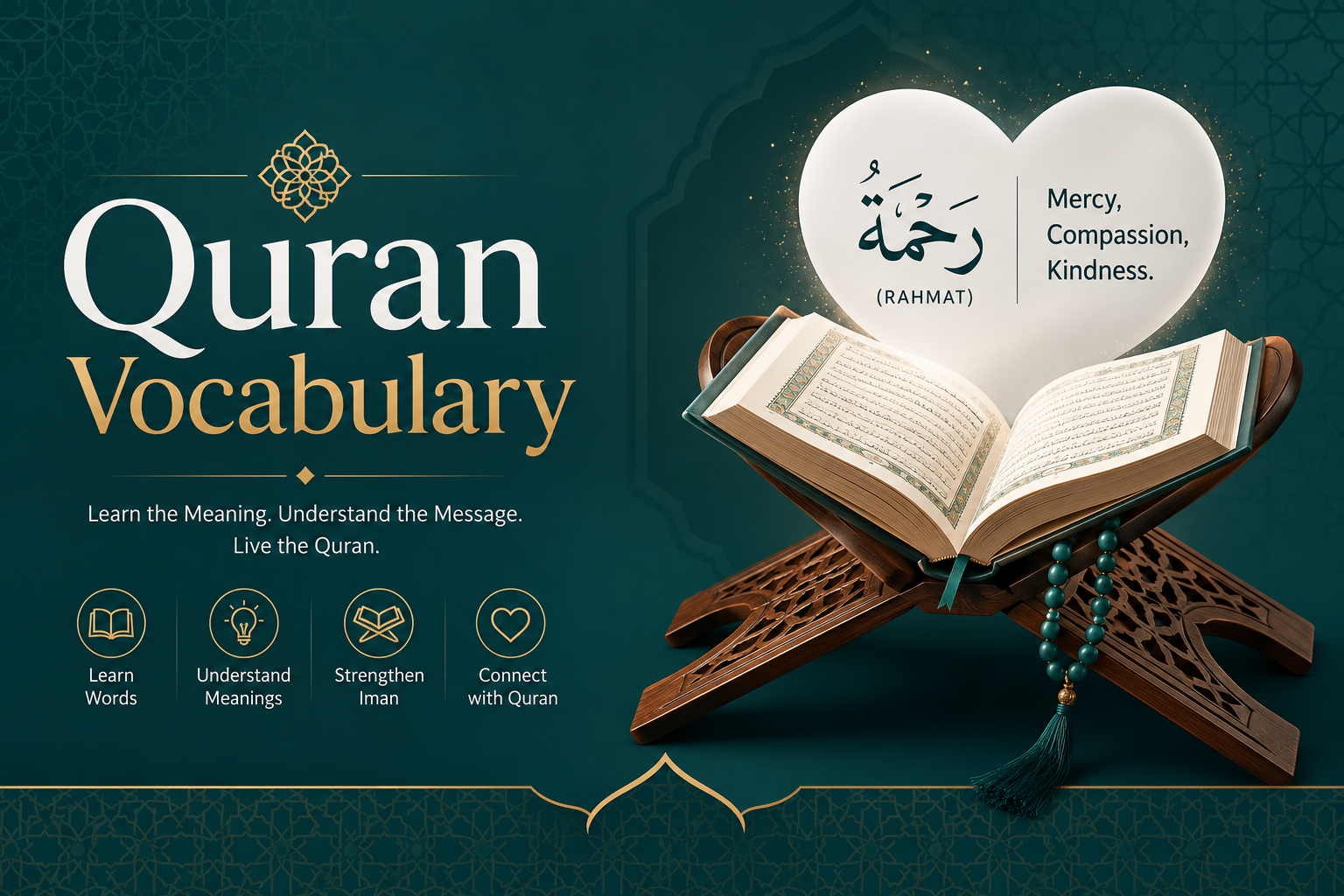
The Quran is a book of guidance, reflection, and profound linguistic beauty. For millions of non-Arabic-speaking Muslims worldwide, reading or listening to the recitation of the Holy Quran is a daily practice. However, there is often a barrier between pronouncing the sacred text and truly understanding its message.
One of the most effective and accessible ways to bridge this gap is through the study of common Quranic words. Rather than attempting to master the entire Arabic dictionary, focusing on high-frequency vocabulary allows learners to unlock a vast portion of the Quranic text in a remarkably short period.
In this comprehensive guide, we will explore the statistical architecture of Quranic vocabulary, break down the most common Quranic words by grammatical category and theme, examine the power of the Arabic root system, and outline practical strategies to incorporate this knowledge into your daily spiritual routine. At Qurania Academy, our Quranic Arabic learning programs are designed to guide students through this journey step by step.
The Statistical Power of Common Quranic Words
The text of the Holy Quran contains approximately 77,800 words across its 114 chapters (Surahs). While this number might initially appear daunting to a student, the reality of Quranic Arabic is far more encouraging. The Quranic text relies heavily on repetition—repetition of core concepts, divine attributes, stories, and essential grammatical structures.
When analyzed linguistically, the Quran contains around 14,850 unique forms, which stem from approximately 1,200 unique three-letter Arabic roots. Furthermore, a very small percentage of these words account for the overwhelming majority of the text.
Total Quranic Words: ~77,800
┌─────────────────────────────────────────┐
│ Top 125 Words (~50% of Total Text) │
├─────────────────────────────────────────┤
│ Top 400 Words (~70–75% of Total Text) │
├─────────────────────────────────────────┤
│ Top 800 Words (~85% of Total Text) │
└─────────────────────────────────────────┘
- The 50% Threshold: Learning just 125 common Quranic words enables a reader to recognize approximately half of every page in the Mushaf.
- The 75% Threshold: Expanding your vocabulary to roughly 400 common Quranic words allows you to understand nearly three out of every four words encountered during recitation.
- The 85% Threshold: Mastering approximately 800 to 1,000 words brings comprehension close to 85–90%, leaving only rare or context-specific terms to be looked up in a translation or commentary (Tafsir).
This mathematical frequency makes learning common Quranic words one of the most efficient paths to direct Quranic understanding.
Categorization of Common Quranic Words by Part of Speech
Arabic vocabulary traditionally divides into three primary categories: Particles (Huruf), Nouns (Asma’), and Verbs (Af’al). Understanding how common Quranic words fit into these categories helps learners build both vocabulary and basic structural awareness.
1. High-Frequency Particles and Prepositions (Huruf)
Particles are short words that connect nouns and verbs, indicate directions, or add emphasis. Though small, particles appear thousands of times throughout the text.
| Arabic Word | Transliteration | Meaning | Approximate Frequency |
| مِنْ | Min | From / Of | 3,226 |
| فِي | Fi | In / Within | 1,701 |
| إِنَّ | Inna | Indeed / Truly / Verily | 1,682 |
| عَلَىٰ | ‘Ala | On / Upon / Against | 1,445 |
| لَا | La | No / Not / Nor | 1,364 |
| إِلَىٰ | Ila | To / Towards | 742 |
| إِنْ | In | If | 578 |
| إِلَّا | Illa | Except / Unless | 558 |
| عَنْ | ‘An | About / From / Away from | 465 |
| قَدْ | Qad | Indeed / Already / Certainly | 406 |
Key Insight: Notice how learning just three prepositions—Min (from), Fi (in), and ‘Ala (upon)—gives you immediate recognition of over 6,000 word occurrences across the Quran.
2. High-Frequency Nouns (Asma’)
Nouns in Quranic Arabic include proper names, pronouns, adjectives, and abstract concepts. The following table showcases some of the most prominent common Quranic words classified as nouns or pronouns:
| Arabic Word | Transliteration | Meaning | Approximate Frequency |
| ٱللَّه | Allah | Allah (God Almighty) | 2,699 |
| ٱلَّذِي | Alladhi | The one who / That which | 1,442 |
| مَا | Ma | What / That which / Not | 1,266 |
| رَبّ | Rabb | Lord / Sustainer / Cherisher | 975 |
| أَرْض | Ardh | Earth / Land | 461 |
| يَوْم | Yawm | Day | 405 |
| قَوْم | Qawm | People / Nation | 383 |
| آيَة | Aayah | Sign / Verse / Proof | 382 |
| رَسُول | Rasool | Messenger | 332 |
| كِتَاب | Kitab | Book / Scripture | 261 |
3. High-Frequency Verbs (Af’al)
Verbs describe actions, states of being, and commands. Quranic verbs frequently convey powerful spiritual dynamic concepts such as creation, faith, guidance, and speech.
- قَالَ (Qala) – He said: Occurs over 1,600 times. Its variations (such as Qalu – “they said”, or Qul – “Say!”) appear continuously across almost every Surah.
- كَانَ (Kana) – Was / Is / To be: Occurs over 1,300 times, used to describe divine attributes, historical states, and eternal truths.
- جَعَلَ (Ja’ala) – He made / He placed: Appears over 340 times, often referring to Allah making the earth habitable, placing light in the skies, or establishing laws.
- عَلِمَ (‘Alima) – He knew: Occurs over 300 times, highlighting divine omniscience and human responsibility to gain knowledge.
- آمَنَ (Aamana) – He believed: Appears hundreds of times, especially in the recurring address “Ya ayyuhalladhina aamanu” (“O you who have believed”).
The Root System: Unlocking Word Families
To truly master common Quranic words, one must understand the genius of Arabic morphology (Sarf). Almost every Arabic word is derived from a core three-letter root (triliteral root). This root carries a fundamental semantic meaning. By modifying the vowel patterns or adding prefix/suffix letters, a single root expands into dozens of distinct words.
Example 1: The Root ر – ح – م (R-H-M)
The fundamental meaning of this root revolves around mercy, compassion, and tenderness.
- رَحْمَة (Rahmah): Mercy / Compassion
- الرَّحْمٰن (Ar-Rahman): The Most Gracious (Encompassing Mercy)
- الرَّحِيم (Ar-Rahim): The Most Merciful (Specific/Continuous Mercy)
- أَرْحَام (Arham): Wombs / Family ties
Example 2: The Root ع – ل – م (‘-L-M)
The core meaning pertains to knowledge, learning, and awareness.
- عِلْم (‘Ilm): Knowledge
- عَالِم (‘Aalim): Knower / Scholar
- عَلِيم (‘Aleem): All-Knowing (Attribute of Allah)
- عَلَّمَ (‘Allama): He taught
- عَالَمِين (‘Aalameen): Worlds / Creation
Example 3: The Root ك – ت – ب (K-T-B)
The basic meaning relates to writing, prescribing, or documenting.
- كِتَاب (Kitab): Book / Scripture
- كَتَبَ (Kataba): He wrote / He prescribed
- مَكْتُوب (Maktoob): Written / Ordained
- كَاتِب (Katib): Scribe / Writer
[ Root: K-T-B (Writing) ]
│
┌───────────────────────┼───────────────────────┐
▼ ▼ ▼
Kitab Kataba Maktoob
(Book) (He wrote) (Written)
By focusing on root patterns, learning one fundamental root unlocks five to ten common Quranic words at once.
Essential Thematic Groups of Common Quranic Words
Organizing common Quranic words into thematic categories makes vocabulary acquisition far more meaningful. Below are key clusters of words frequently found together in the text.
1. Divine Attributes and Names of Allah
The Quran is primarily an introduction to God, His nature, and His relationship with creation. As a result, Allah’s names are among the most frequently repeated terms in the entire text:
- الْعَزِيز (Al-Azeez): The Almighty / The All-Mighty
- الْحَكِيم (Al-Hakeem): The All-Wise
- الْغَفُور (Al-Ghafoor): The Oft-Forgiving
- الْعَلِيم (Al-‘Aleem): The All-Knowing
- الرَّؤُوف (Ar-Ra’oof): The Kind / The Affectionate
- الْقَدِير (Al-Qadeer): The All-Powerful / Capable over all things
2. Creation, Nature, and the Universe
Allah continuously directs human attention to the physical world as signs (Aayaat) of His existence and power.
- سَمَاء (Samaa’ / Plural: Samawat): Sky / Heavens (310+ times)
- أَرْض (Ardh): Earth / Land (461 times)
- شَمْس (Shams): Sun
- قَمَر (Qamar): Moon
- لَيْل (Layl): Night (82 times)
- نَهَار (Nahar): Day (as light)
- مَاء (Maa’): Water
3. Faith, Worship, and Moral Character
These words represent the core tenets of Islamic belief and practical living:
- إِيمَان (Eeman): Faith / Belief
- صَلَاة (Salah): Prayer / Connection (83 times)
- زَكَاة (Zakah): Purifying Charity
- صَبْر (Sabr): Patience / Perseverance
- شُكْر (Shukr): Gratitude / Thankfulness
- تَقْوَى (Taqwa): God-consciousness / Piety
- إِحْسَان (Ihsan): Excellence / Goodness
4. The Hereafter and Eschatology (Al-Aakhirah)
Reminders of the Day of Judgment and the ultimate destination of humanity form a central theme of Quranic discourse:
- آخِرَة (Aakhirah): The Hereafter / The End
- دُنْيَا (Dunya): The worldly life / The present world
- قِيَامَة (Qiyamah): Resurrection
- جَنَّة (Jannah / Plural: Jannat): Paradise / Gardens (96 times)
- نَار (Naar): Fire / Hellfire (145 times)
- عَذَاب (‘Azaab): Punishment / Torment (322 times)
- أَجْر (Ajr): Reward / Recompense (105 times)
Practical Application: Analyzing Common Quranic Words in Daily Surahs
To illustrate how these vocabulary words function in context, let us examine two frequently recited chapters: Surah Al-Fatihah and Ayat al-Kursi (Surah Al-Baqarah, 2:255).
Analysis of Surah Al-Fatihah
Surah Al-Fatihah consists of seven short verses, yet almost every word in this Surah belongs to the high-frequency category:
- بِسْمِ اللَّهِ الرَّحْمَٰنِ الرَّحِيمِ
- Ism (Name), Allah (God), Ar-Rahman (The Most Gracious), Ar-Rahim (The Most Merciful).
- الْحَمْدُ لِلَّهِ رَبِّ الْعَالَمِينَ
- Al-Hamd (Praise), Rabb (Lord/Sustainer), Al-‘Aalameen (The Worlds).
- الرَّحْمَٰنِ الرَّحِيمِ
- Repeated attributes of mercy.
- مَالِكِ يَوْمِ الدِّينِ
- Malik (Master/Owner), Yawm (Day), Ad-Deen (Judgment/Religion).
- إِيَّاكَ نَعْبُدُ وَإِيَّاكَ نَسْتَعِينُ
- Na’budu (We worship – root ‘-B-D), Nasta’een (We seek help – root ‘-W-N).
- اهْدِنَا الصِّرَاطَ الْمُسْتَقِيمَ
- Ihdina (Guide us – root H-D-Y), As-Sirat (The Path), Al-Mustaqeem (The Straight).
- صِرَاطَ الَّذِينَ أَنْعَمْتَ عَلَيْهِمْ…
- Alladhina (Those who), ‘Ala (Upon).
Recognizing these common Quranic words transforms the daily recitation of Al-Fatihah from passive repetition into an active, conscious conversation with the Creator.
Benefits of Learning Common Quranic Words
Focusing on high-frequency vocabulary offers numerous spiritual, mental, and practical benefits:
1. Enhanced Concentration in Prayer (Khushu’)
One of the most common challenges during daily prayers (Salah) is mind-wandering. When you understand the common Quranic words being recited by yourself or the Imam, your mind stays engaged with the meaning, directly fostering deeper Khushu’ (humility and focus).
2. Rapid Learning Curve
Attempting to learn classical Arabic grammar completely before reading the Quran can sometimes feel overwhelming. Starting with common Quranic words delivers immediate results. Within a few weeks, learners notice that they can identify words on almost every line of the Quranic text. To fast-track your progress, you can explore our structured Quranic Arabic courses guided by experienced tutors.
3. Facilitation of Deep Reflection (Tadabbur)
The Quran explicitly encourages believers to ponder its verses:
“This is a blessed Book which We have revealed to you, [O Muhammad], that they might reflect upon its verses and that those of understanding would be reminded.” > — Surah Sad (38:29)
Reflecting (Tadabbur) requires understanding the primary meaning of the words. Knowing the core vocabulary serves as the foundation for reading commentaries (Tafsir) and absorbing the moral and spiritual lessons.
Step-by-Step Strategy to Memorize Common Quranic Words
To effectively learn and retain these words, follow a structured study plan designed for long-term retention.
[ Step 1: Set a Daily Goal (5-10 Words) ]
│
▼
[ Step 2: Utilize Spaced Repetition (SRS) ]
│
▼
[ Step 3: Contextualize in Daily Recitation ]
│
▼
[ Step 4: Study Roots & Word Families ]
Step 1: Set a Realistic Daily Goal
Commit to learning 5 to 10 new common Quranic words per day.
- Learning 10 words per day equals 300 words per month.
- In just six weeks, you will have covered the top 400 words that make up over 70% of the Quranic text!
Step 2: Use Spaced Repetition Systems (SRS)
Spaced repetition is a proven learning technique where flashcards are reviewed at increasing intervals. Digital flashcard applications (such as Anki or dedicated Quranic vocabulary apps) allow you to review high-frequency words efficiently, ensuring that words move from short-term to long-term memory.
Step 3: Connect Vocabulary to Short Surahs
Always learn words in context rather than isolation. When you learn a new word—such as Ardh (Earth) or Samaa’ (Sky)—find three verses where that word appears. Reviewing the word within a full verse helps anchor its meaning and grammatical usage.
Step 4: Keep a Dedicated Quran Vocabulary Journal
Maintain a notebook specifically for common Quranic words. Divide your journal entries by root letters or thematic topics. Writing the Arabic script by hand strengthens visual and kinesthetic memory.
Frequently Asked Questions
Q1: Do I need to master Arabic grammar (Nahw and Sarf) before studying common Quranic words?
Ans: No. In fact, learning vocabulary first makes studying grammar much easier later on. When you eventually learn grammar rules, you will already be familiar with the words used in the example sentences.
Q2: How long does it take to learn the top 400 common Quranic words?
Ans: If you study consistently for 15 to 20 minutes a day and learn 10 words each day, you can master the top 400 words in approximately 40 to 60 days, including time for review. If you prefer learning with professional guidance, feel free to review our affordable fee structure to choose a flexible plan.
Q3: Where can I find reliable lists of high-frequency Quranic vocabulary?
Ans: High-frequency word lists are available through academic resources such as the Quranic Arabic Corpus (corpus.quran.com), dedicated books on Quranic vocabulary (e.g., 80% of Quranic Words), and various educational mobile apps focused on Quranic Arabic.
Conclusion
The journey toward understanding the Quran does not require years of immersion in complex linguistic theory before you can experience its beauty. By strategically focusing on common Quranic words, non-native speakers can quickly access the direct meaning of the revelation.
Every preposition mastered, every root word understood, and every divine attribute memorized brings the reader one step closer to fulfilling the Quran’s invitation to listen, comprehend, and reflect. Start small, remain consistent, and let the study of these timeless words transform your relationship with the Holy Quran.